

Replays
Executive summary
Québec City–Toronto High-Speed Rail: Looking Beyond the Costs to the Expected Benefits
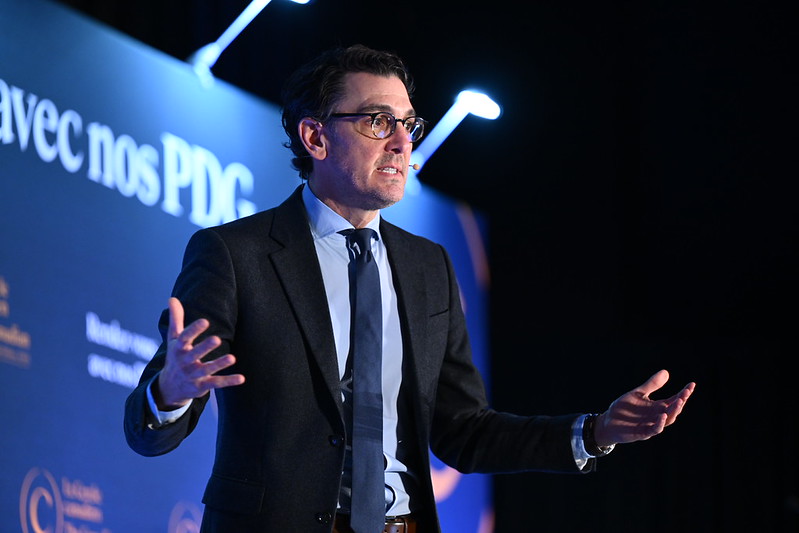
Can Canada afford to go without high-speed rail? Martin Imbleau, President and Chief Executive Officer of Alto, is convinced it cannot. Speaking at the Canadian Club of Montréal on November 23, he made the economic case for the project while directly addressing the challenges of cost, construction and integration into the communities and regions along the route. Led by Alto, a federal Crown corporation, in collaboration with a six-company consortium headed by CDPQ Infra, the project calls for the construction of 1,000 kilometres of electrified railway tracks dedicated to passenger service between Québec City and Toronto. The trains, designed to travel at 300 km/h, will each accommodate 600 passengers. The goal: to cut travel times in half. For Martin Imbleau, however, the ambition goes far beyond transportation. “The success of an infrastructure project isn’t measured by what we build, but by what it truly makes possible.”
Learn more
Bringing economic hubs closer together
The Québec City–Toronto corridor currently accounts for 40% of Canada’s population and generates an equivalent share of the country’s GDP. Over the next 15 years, its population is expected to grow from 17 million to 21 million. Yet 97% of intercity trips are still made by car, the speaker noted.
By bringing cities closer together, Alto would enable businesses to expand their talent pools, workers to access more employment opportunities and scientific researchers to broaden their collaborations. Martin Imbleau gave the example of a Laval-based life sciences company that could recruit an expert from Trois-Rivières without requiring her to relocate.
“It may seem like a small example, but multiply that by thousands of workers, thousands of businesses, hundreds of communities, researchers, students and customers. That’s where high-speed rail changes lives,” he emphasized.
A recent study commissioned by Alto from Aviseo Conseil estimates that high-speed rail could add more than $24 billion annually to Canada’s GDP once the network is complete. The CEO also highlighted the creation of 50,000 jobs during construction and 5,000 during operations, as well as $800 million in annual economic benefits for the tourism sector.
Why opt for high-speed rail?
During the conversation that followed his address, moderated by Stéphanie Grammond, Editor-in-Chief of La Presse’s editorial pages, the CEO defended the choice of high-speed rail over high-frequency rail. He confirmed that a comparative analysis had been conducted and that all three consortiums consulted had reached the same conclusion. “The costs are similar, but the benefits are five to six times greater with high-speed rail.”
In his view, the high-frequency rail project, estimated at $12 billion by VIA Rail in 2021, faces significant constraints. Using existing railway rights-of-way would require numerous expropriations and force the suspension of freight transportation during construction. In a new corridor, high-frequency rail would cost between $40 billion and $50 billion, with considerably fewer benefits. “Why build something outdated when we have a solution that works throughout the Western world?”
Travellers must still be persuaded to switch from cars or planes to rail. To achieve this, he stressed, three conditions must be met: substantial time savings, three or four departures per hour during peak periods, and competitive fares.
Avoiding cost overruns
How can the project avoid the cost overruns that have plagued certain railway projects abroad, particularly in the United Kingdom? Martin Imbleau favours a phased approach, with construction of the network divided into three separate worksites. He is also drawing on private-sector expertise and lessons learned from international experience.
One of the mistakes to avoid, he emphasized, is continually changing the scope of the project once construction is underway — the infamous “while we’re at it” additions.
The final cost, however, remains uncertain. While Alto estimates it at between $60 billion and $90 billion, the Parliamentary Budget Officer has put forward a range of $75 billion to $113 billion. Alto intends to update its estimates once the project’s scope is better defined and engineering studies are at least 10% complete along the entire route.
Time is also of the essence for financial reasons. “Every year that we don’t build or that we delay adds another $3 billion to $4 billion because of inflation,” he estimated.
Competition for labour represents another challenge, particularly given Hydro-Québec’s construction projects and Ontario’s major energy and public transit initiatives. Alto is already working to organize its supply chain, drawing in part on small and medium-sized enterprises and First Nations businesses.
Navigating political opposition
Adding to these challenges is the need to work with a Quebec government that is not particularly supportive of the project. During the election campaign, Premier Paul St-Pierre Plamondon expressed his opposition to high-speed rail, preferring that the funds be allocated to maintaining aging infrastructure.
Asked by Stéphanie Grammond to respond, Martin Imbleau pointed out that the project would span several electoral cycles. Convinced of its economic benefits for both Quebec and Ontario, he is leaving the matter to the federal and provincial ministers of transportation to discuss. However, there is no question of revising the timeline. “We’ll be ready to launch the second phase of consultations in the coming weeks and begin construction in 2029,” he stated.
A more clearly defined route coming soon
Asked about the concerns of landowners and farmers, the CEO confirmed that Alto would unveil a corridor a few hundred metres wide in the coming weeks, compared with approximately ten kilometres initially. A second phase of consultations will follow. The final right-of-way, approximately 60 metres wide, is expected to be established by the end of 2027.
To minimize the fragmentation of agricultural land and maintain access, Alto plans to build overpasses, underpasses and bypass roads, among other measures. Farmers who experience a loss of productivity despite these measures will be compensated based on estimated losses over a 100-year period, he explained.
The network will serve seven cities: Québec City, Trois-Rivières, Laval, Montréal, Ottawa, Peterborough and Toronto. Kingston could also be added to the list. Its population base would justify an additional stop that would extend the journey by only a few minutes, Martin Imbleau explained.
In Montréal, Alto favours a downtown station accessible through a tunnel. Options regarding its location and the route will be presented shortly.
The cost of inaction
For Martin Imbleau, the debate surrounding the project’s costs must also take into account the financial consequences of maintaining the status quo. By mid-century, Quebec and Ontario will need to invest $50 billion annually in transportation infrastructure to meet the needs of a growing population, the CEO pointed out.
“We shouldn’t compare Alto to zero. We should compare it to what we’ll have to invest anyway if nothing changes,” he emphasized.
Unlike road infrastructure, high-speed rail is expected, under the proposed business model, to generate sufficient revenue to cover its operating and maintenance costs.
Above all, the CEO fears that, a decade from now, Canada will regret not having seized this opportunity to modernize its infrastructure and improve its productivity.
“The best time to do it was yesterday. The second-best time to do it is today,” he concluded.
We don’t build infrastructure for its own sake. We build it for what it enables. The goal of high-speed rail is to cut travel times roughly in half and make same-day round trips possible across the network. »
Martin Imbleau

Go directly to the sections that interest you the most:
Biographie(s)
Martin Imbleau
For 30 years, Martin Imbleau has been developing, constructing and operating large-scale infrastructure projects across multiple Canadian provinces, the United States and internationally - including gas pipelines, liquefied natural gas terminals, wind farms and port facilities. His career has been built at the heart of major public and industrial initiatives, at the intersection of technical, economic and social issues. His vast network - spanning Indigenous communities, international experts, corporate decision-makers and all levels of government - is now a strategic asset for Alto. Before joining Alto, Mr. Imbleau was CEO of the Montreal Port Authority. Under his guidance, the organization built a reputation as an environmental and sustainable development leader. At Hydro-Québec, he was Vice-President, Corporate Strategy and Business Development for Canada and the United States. He also worked for Énergir as Vice-president where he was responsible for several key files, including renewable energy, community relations, safety, gas supply and transportation. Martin holds a master's in law from Université de Montréal and a bachelor's in law from Université du Québec à Montréal. He has been a member of the Barreau du Quebec since 1997. While working on the development of major infrastructures, he pursues his commitment to defending human rights around the world and has authored numerous works on international law as it regards human rights, genocide and transitional justice. Mr. Imbleau is Chairman of the board of directors of Université du Québec à Montréal's Raoul Dandurand Chair in Strategic and Diplomatic Studies. He is the cofounder of the Chaire de gestion du secteur de l'énergie at HEC Montréal.
EVENT SPONSOR
INFORMATIONS
This conference took place on November 23, 2026, at the Fairmont Queen Elizabeth.
Major partner

Commanditaires de saison


Media partner








































Administrative Offices
1250 Boulevard René Lévesque West, suite 2200
Montréal (Québec) H3B 4W8


Principal Partner

Season Sponsors


Privacy Policy - © Canadian Club of Montreal Année - Website by Riposte
