

Replays
Executive summary
Velocity and Innovation as Strategy: Building Canada's Giants of Tomorrow
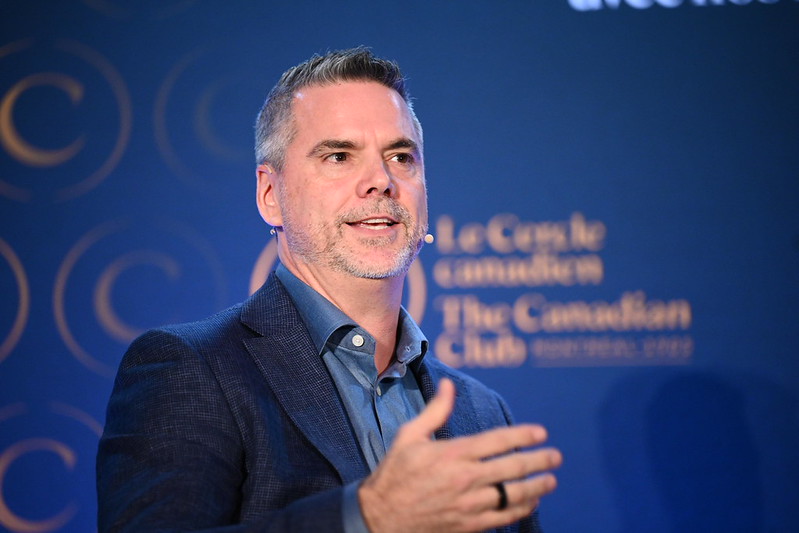
Canada trains approximately 10% of the world’s top talent in artificial intelligence (AI), yet captures only 2% of the venture capital invested in the sector globally. For Chris Arsenault, Founding Partner at Inovia Capital, this imbalance illustrates a very specific challenge: the country innovates, but still struggles to turn that expertise into economic power. Speaking before members of the Canadian Club on May 11, Arsenault called for faster adoption of innovation and greater support for homegrown technology companies in order to create value here in Canada. “Canada does not have a supply problem in AI. It has a demand problem,” he said. The situation is concerning, in his view. In 2024, two-thirds of high-potential Canadian startups were based outside the country.¹ More than half of the venture capital invested in Canada also came from the United States.² As a result, the country produces researchers, entrepreneurs and cutting-edge technologies, yet a significant share of the value they create is captured elsewhere. “We are leaders in research, but underrepresented in value creation,” Chris Arsenault summarized. In his view, Canada has now reached an “inflection point,” as advances in AI move beyond university laboratories and become companies capable of transforming entire industries. The challenge now is to create the conditions that will allow those companies to grow here.
Learn more
Speed as a Strategic Advantage
The word that comes up constantly in his talk: speed. For Chris Arsenault, the ability to make decisions and act quickly has become a key competitive advantage. In large technology ecosystems, he says, moving fast is no longer even an advantage. “It’s the baseline requirement. ”
The problem, he argues, is that too many Canadian organizations remain paralyzed by analysis and the search for certainty before taking action. While they’re thinking, their competitors are moving forward. “Today, slowness is a greater risk than making a mistake,” he maintained.
He compares this dynamic to a game of Snakes and Ladders: while a company piles up analyses and plans, a more agile competitor is already changing the rules of the game. The result: the process must be restarted from the beginning, always with an additional delay.
To illustrate this contrast, Chris Arsenault cites the American model. In the United States, large companies quickly adopt new technologies, governments act as early adopters, and major corporations invest heavily in startups and venture capital funds.
“Innovation is a catalyst for growth and a competitive advantage, and they’ve understood that,” he stated.
From the Gaspé Peninsula to the Global Tech Scene
The personal journey of Inovia’s founder directly fuels this vision. A native of Bonaventure, in the Gaspé Peninsula, Chris Arsenault says he realized the potential of technology at a very early age when he discovered a TRS-80 computer. “Technology could rewrite the rules in almost every industry,” he explained.
This conviction led him to launch his first Internet company in the 1990s, and then to found Inovia Capital in 2007 with an initial fund of 112 million Canadian dollars.
Nearly twenty years later, the firm manages more than 2.5 billion U.S. dollars and has offices in Montreal, Toronto, Waterloo, Calgary, London, and Abu Dhabi.
The executive also highlights just how much the Canadian ecosystem has changed. In 2007, approximately $550 million was invested annually in Canadian technology companies. By 2025, that figure had surpassed $5.8 billion U.S.
Last year alone, companies in Inovia’s portfolio raised 1.7 billion U.S. dollars. Among them are Cohere and Wealthsimple.
Turning Research into Businesses
To accelerate the development of AI in Canada, Inovia is launching a series of initiatives. Chris Arsenault specifically mentioned the partnership with Mila, the Quebec Institute for Artificial Intelligence, to raise the Venture Scientist Fund, totaling approximately $100 million. The goal: to help researchers turn their work into technology companies based here rather than in the United States.
Inovia has also assembled a team of AI experts made up of former employees from Google DeepMind, Anthropic, OpenAI, and certain portfolio companies, including Cohere. Their role is to accelerate the integration of AI into the portfolio companies.
The executive believes, however, that the real challenge goes far beyond funding. Canada must create more local demand for its technologies. “Convincing our governments and large companies to adopt innovation and AI as a strategy” remains essential, he emphasized.
According to him, Canadian startups still struggle to find their first major clients domestically. “Too often, these clients are in the United States.”
A Matter of Economic Sovereignty
In conclusion, Chris Arsenault placed innovation within a broader geopolitical context. The United States is investing heavily in its technology leaders. For more than a decade, China has been pursuing a clear strategy of technological sovereignty. Europe is now seeking to strengthen its strategic partnerships.
In this context, he believes Canada can no longer remain neutral. “Failing to invest in our own Canadian champions means choosing to depend on those of others.”
The executive therefore views innovation as a matter of economic sovereignty as much as it is one of growth. The goal, he says, is to build companies that create jobs here, develop their intellectual property here, and pay their taxes here—all while expanding their reach internationally.
“Canada has all the ingredients: talent, AI research, accountability, diversity, and great institutions. What’s needed is a mindset of agility,” concluded Chris Arsenault.
Canada doesn't have a problem with the supply of AI. It has a problem with demand. »
Chris Arsenault

Go directly to the sections that interest you the most:
- Mot de bienvenue
- Les piliers de la stratégie : IA et vélocité
- L’essor d’Inovia et de l’écosystème canadien
- Le "Paradoxe canadien" et la recherche en IA
- Souveraineté économique et IA native
- Vélocité décisionnelle : le risque de ralentir
- Vision d’avenir : compétition et responsabilité
- Discussion : leadership et gestion de l’erreur
- Cas concrets d'intégration de l'IA & productivité
- Ambition pour les 20 prochaines années
- Mot de la fin
Biographie(s)
Chris Arsenault
Chris Arsenault is a driving force in Canada’s growing technology ecosystem, with more than 25 years of experience in management and investing. He has played a key role in supporting numerous successful companies and has built an impressive track record of identifying high-potential individuals and businesses, maximizing transaction value, and guiding management teams through growth and successful exits. Chris co-founded Inovia Capital in 2007, helping shape the firm’s culture and vision. His entrepreneurial instincts led to the creation of the Inovia platform and the firm’s growth funds, helping propel its success. With an unwavering commitment to Canada’s technology landscape, Chris has played an instrumental role in supporting global companies such as AppDirect, Lightspeed Commerce, Luxury Retreats, Poka and Super.com. Currently serving on the boards of AppDirect, Super.com and Talent.com, Chris provides valuable guidance and strategic insight. His leadership has contributed to several notable exits, including the initial public offerings of Lightspeed Commerce and Sonder, as well as the acquisitions of Luxury Retreats by Airbnb, Well.ca by McKesson, Poka by IFS, Return Magic by Shopify, Smooch by Zendesk, Localmind by Airbnb, Reflex Photonics by Smiths Interconnect, Routehappy by ATPCO, Airborne Entertainment by Cybird, and SIT by Ubizen, generating substantial value for shareholders. Chris is also actively involved in community initiatives and serves on the boards of the Montreal Heart Institute Foundation, the campaign cabinet of the CHU Sainte-Justine Foundation, and Groupe Dynamite. As a proud member of C100, a renowned Silicon Valley organization, Chris continues to foster collaboration and innovation across borders. Through his extensive experience, entrepreneurial mindset and strong industry relationships, Chris Arsenault has established himself as a pillar of Canada’s technology landscape. His commitment to identifying high-potential companies, maximizing their value and supporting their growth has had a lasting impact on the ecosystem. Biography 2026
EVENT SPONSOR

INFORMATIONS
This conference took place on May 11, 2026, at the Fairmont The Queen Elizabeth in Montreal.
Major partner

Commanditaires de saison


Media partner


















Administrative Offices
1250 Boulevard René Lévesque West, suite 2200
Montréal (Québec) H3B 4W8


Principal Partner

Season Sponsors


Privacy Policy - © Canadian Club of Montreal Année - Website by Riposte
