

Replays
Executive summary
CGI: 50 Years of Growth, and Still Looking Toward the Future
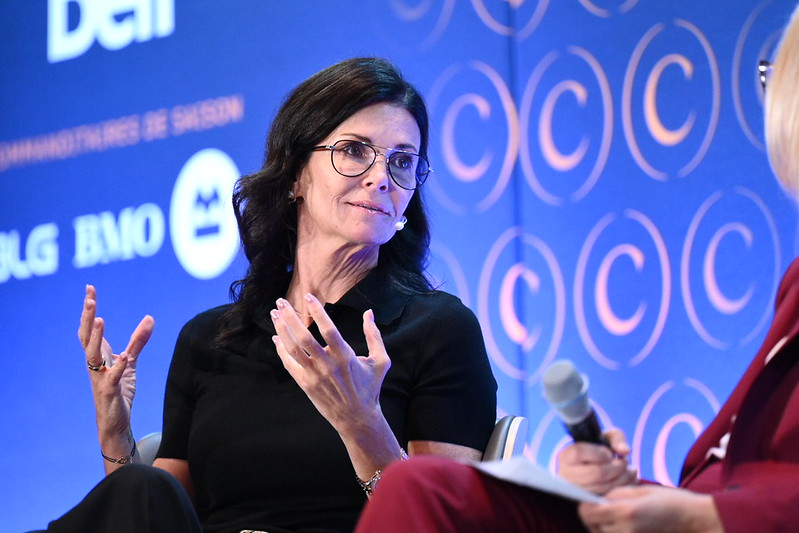
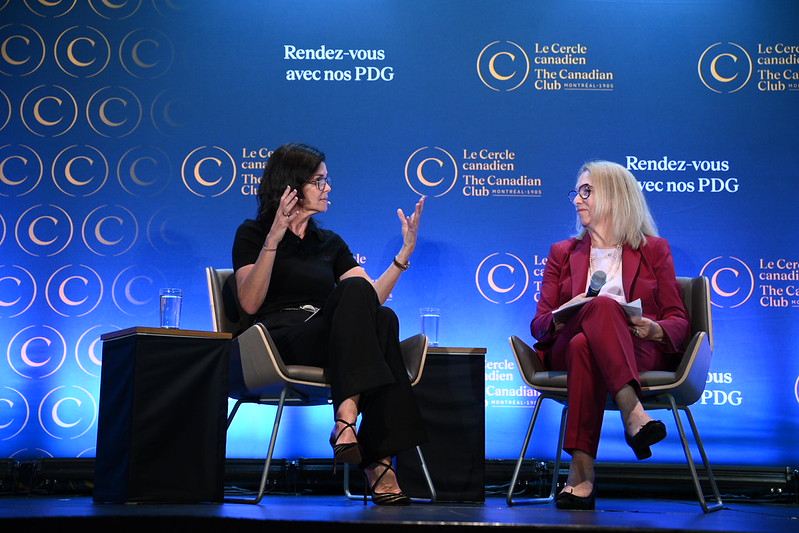
Few Canadian companies can claim to have navigated five decades of technological upheaval while continuing to grow on a global scale. As CGI celebrates its 50th anniversary, Julie Godin, Executive Chair of the Board, says that the principles that have guided the company since its beginnings — close client relationships, disciplined execution and a long-term vision — remain more relevant than ever. Speaking at the Canadian Club of Montreal on June 15, she shared her perspective on the major transformations currently reshaping the technological and economic landscape in a conversation with Jacinthe Côté, an independent member of CGI’s Board of Directors. Today, the firm has approximately 85,000 professionals across some 40 countries and serves approximately 5,500 clients in more than a dozen industries. The company generates nearly C$16 billion in annual revenue, with approximately 45% coming from North America and 55% from Europe. Canada alone accounts for nearly 10% of revenue, while Quebec represents approximately 5%. For Julie Godin, this growth is driven less by technology itself than by the organization’s ability to build lasting relationships with its clients and execute its engagements with discipline. “Thanks to this disciplined approach to execution, 94% of our projects are delivered on time and within budget,” she emphasized.
Learn more
The Foundations of a Sustainable Model
When asked about CGI’s ability to navigate the many economic cycles of the past five decades, Julie Godin highlighted three elements that she considers the company’s core pillars: a decentralized model, a diversified service offering, and the rigorous operational discipline mentioned earlier.
Unlike many large technology companies, CGI is organized around local markets and industries rather than technologies. Its teams are therefore positioned close to clients and decision-making centres, allowing them to develop an in-depth understanding of the industries they serve.
“A CIO [Chief Information Officer] does not manage just one or two technologies over the course of a career; they have to navigate an entire ecosystem. To remain relevant, we first need to understand their industry, their challenges and the complexity of their environment,” Julie Godin explained.
This proximity enables CGI’s teams to build long-term relationships with the organizations they serve and gain a deeper understanding of the challenges they face. It also provides an advantage when companies go through periods of uncertainty.
Julie Godin noted that CGI has had to navigate several major crises throughout its history, including the bursting of the dot-com bubble, the 2008 financial crisis and the COVID-19 pandemic. According to her, relying on clear and consistent management principles has enabled the company to stay the course despite periods of turbulence.
“When uncertainty increases, we always go back to our fundamentals. It allows us to act with urgency, but not with panic.”
At the heart of its clients' operations
The discussion also highlighted just how deeply CGI is integrated into the operations of many organizations.
A significant portion of the company’s revenue comes from long-term managed services, which places its teams at the very heart of its clients’ operations. Whether it’s payment systems, government platforms, or energy infrastructure, the technologies developed or operated by CGI support essential activities on a daily basis.
This proximity provides a significant strategic advantage, according to Julie Godin. By working directly within their clients’ operational environments, the teams gain in-depth knowledge of their challenges and are able to propose solutions tailored to their actual needs.
“We don’t innovate just for the sake of innovation. Innovation must address a concrete need and create value on a large scale,” she said.
Digital Sovereignty Takes Center Stage
One of the topics that generated the most interest during the meeting was data sovereignty.
Julie Godin noted that governments and many large organizations are now paying closer attention to where their data is stored, who can access it, and which jurisdictions govern it.
“Data sovereignty has become a strategic issue for governments around the world,” she said.
According to her, recent geopolitical tensions have accelerated this trend. Many public administrations are currently reassessing their technology infrastructures to reduce certain dependencies and better control their digital assets.
CGI is therefore developing various solutions that enable organizations to maintain greater control over their data, particularly in the areas of cloud computing and artificial intelligence.
The Real Challenge: Adapting Organizations
Beyond technological advances, Julie Godin believes that the main challenge in the coming years will be organizational. While AI opens the door to significant productivity gains, it also requires companies to rethink their processes, responsibilities and ways of working. In her view, the most significant benefits will come not only from the tools themselves, but from organizations’ ability to adapt the way they operate.
She often compares companies’ technology environments to a massive puzzle to which new pieces are constantly being added. In this context, AI can help simplify certain tasks, reduce costs and better manage the growing complexity of digital environments.
She also distinguishes between several categories of potential benefits. Some relate directly to efficiency gains. Others involve modernizing existing systems or the emergence of new business models that remain difficult to imagine today.
Beyond the technology itself, however, she believes the real challenge lies in helping organizations make strategic choices. “The learning curve is getting steeper and steeper,” she noted.
Julie Godin also believes that organizations need to start preparing now for the next waves of technology, particularly quantum computing. Although applications remain limited for now, CGI is already investing in developing expertise in this field and building an ecosystem of partners to better understand the opportunities it could create. This preparation also includes a focus on cybersecurity and risk management, two issues that are expected to become even more important in the years ahead.
A Well-Prepared Next Generation
One of the most personal moments of the conversation focused on the transition between Julie Godin and her father, Serge Godin, the founder of CGI.
Julie Godin explained that this leadership transition did not happen overnight. Over nearly 15 years, she gradually took on different responsibilities within the company in order to gain a deep understanding of its operations, culture and decision-making processes.
This gradual approach allowed her to develop an in-depth knowledge of the organization before assuming greater strategic responsibilities. Today, she sees it as one of the reasons behind the success of the transition.
Building for the Long Term
As the conversation drew to a close, Julie Godin reflected on what she considers one of CGI’s defining characteristics since its early days: its owner-shareholder culture.
She noted that 88% of the company’s partners own CGI shares and that, collectively, they hold approximately 8% of the company’s equity, making them the second-largest shareholder group after major institutional investors.
This owner-shareholder culture fosters a strong sense of commitment and encourages employees to take a long-term perspective, both in their decision-making and in their relationships with clients.
For Julie Godin, this ability to align the interests of employees, clients and shareholders has been one of the key drivers of CGI’s growth since its founding. She considers this balance essential to enabling the company to continue growing in an ever-evolving technological environment.
“If century-old companies can exist in other industries, why couldn’t CGI still be here 100 or 150 years from now?” she said, convinced that the principles behind the company’s past success will also be the keys to its future.
Data sovereignty has become a strategic issue for governments around the world. »
Julie Godin
Go directly to the sections that interest you the most:
Biographie(s)
Julie Godin
Julie Godin is Executive Chair of the CGI Board of Directors. Today, CGI is one of the largest independent IT and business consulting services firms in the world and operates in more than 400 metro markets across 40 countries worldwide. CGI partners with more than 5,500 clients globally to digitally transform their organizations through an end-to-end portfolio of capabilities: high-end IT and business consulting, systems integration, managed IT and business process services, and intellectual property solutions. Biography 2025
As part of her mandate, Ms. Godin guides and collaborates with the Board and the executive team to set the strategic direction of the company, including overseeing the development and execution of its rolling three-year strategic plan. She focuses on achieving results for and maintaining equilibrium among CGI’s three stakeholders—clients, CGI Partners and shareholders—to ensure each stakeholders’ long-term success.
Ms. Godin joined CGI in 2009. Prior to her appointment as Executive Chair, she incrementally assumed responsibility for leading a range of enterprise functions that drive the company’s long-term strategic direction and Build and Buy profitable growth strategy. These critical global functions span human resources, including the design of CGI’s executive compensation programs; strategic planning; mergers and acquisitions; business consulting; CIO; marketing and communications; security; procurement and global business shared services.
Earning a bachelor’s degree in kinesiology from the University of Sherbrooke, Ms. Godin began her career in the field of corporate health. In 2004, she founded Oxygen, a company that manages comprehensive health and well-being programs in the workplace. As CEO, she drove the firm’s strategic planning and growth, overseeing all operations and working closely with major clients. Oxygen merged its activities with those of CGI to offer CGI Partners worldwide a complete range of health and well-being services.
From 2017 to 2021, Ms. Godin was a member of the Board of Directors of Canadian National, a transportation leader in North America. In 2000, she co-founded the Godin Family Foundation with a mission to alleviate poverty, promote education and improve the health of children and teens in need. Since its inception, the Foundation has helped more than 400 schools, hospitals, and youth organizations. She is also actively involved in multiple charitable organizations, notably acting as chair for fundraising and other campaigns to serve communities across Canada.
EVENT SPONSOR

INFORMATIONS
This conference took place on June 15, 2026, at the Palais des congrès in Montreal.
Major partner

Commanditaires de saison


Media partner

















Administrative Offices
1250 Boulevard René Lévesque West, suite 2200
Montréal (Québec) H3B 4W8


Principal Partner

Season Sponsors


Privacy Policy - © Canadian Club of Montreal Année - Website by Riposte
