

Replays
Executive summary
Defence: Time to Deliver
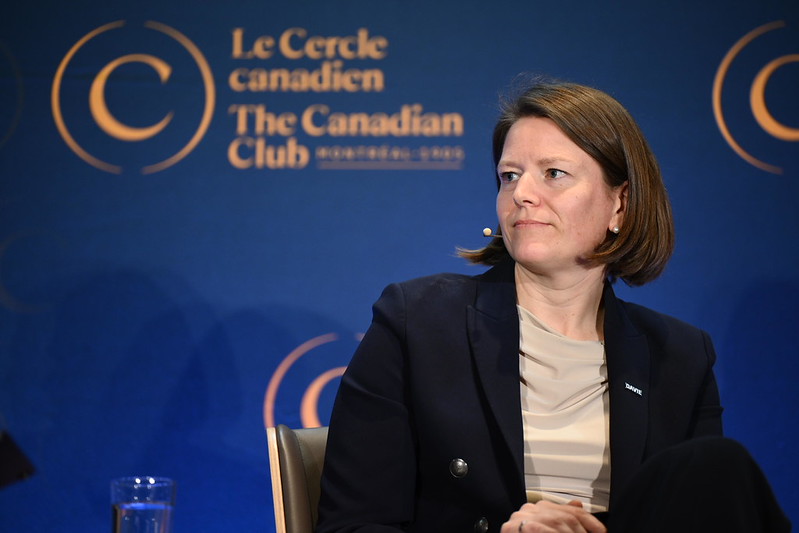
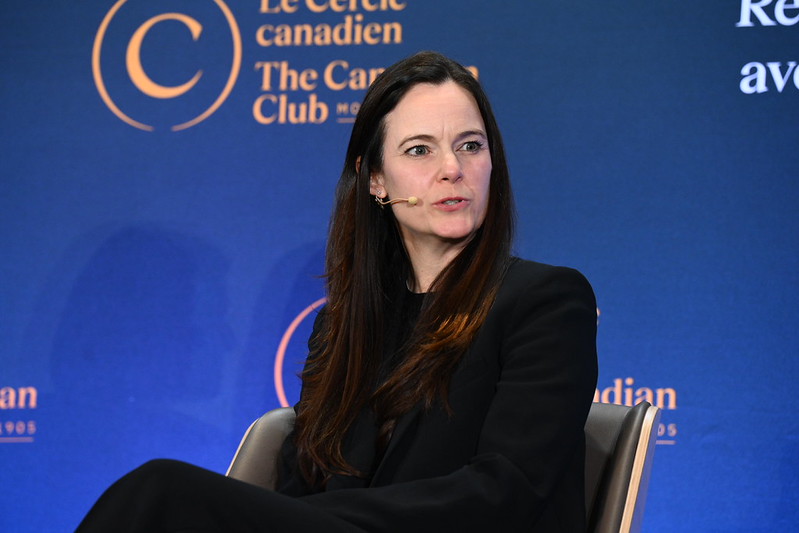
Canada has not invested this heavily in defence since the 1950s. How can this surge in funding be transformed into lasting opportunities for Canadian businesses? That was the central question explored during a panel hosted by the Canadian Club of Montreal on Canada's industrial sovereignty. Lindsey Kettel, President of Chantier Davie Canada, and Faith Rhodes, Chief Operating Officer and President of the Canadian Market at Marconi Technologies, emphasized the urgency of accelerating domestic production, acquiring critical technologies and expanding into global markets. The discussion also highlighted the leadership of women in a rapidly growing strategic industry. The panel was moderated by Gaëlle Rivard Piché, Executive Director of the Conference of Defence Associations and its Institute. At the outset, she underscored the scale of the shift initiated by Mark Carney's government: a target of 5% of GDP in defence spending by 2035, more than $80 billion over five years for the Canadian Armed Forces, and a new defence industrial strategy built around three pillars: build, partner and buy. “We are living through a unique moment,” she summarized.
Learn more
Owning the Technology
For Faith Rhodes, industrial sovereignty means being able to serve national priorities. In areas such as advanced technology and artificial intelligence, simply retaining decision-making authority in Canada is no longer enough: the country must own the technologies it relies on.
“When the time comes to act, we need to be able to modify the technology to respond to the next threat. And we can only do that if we own the intellectual property, the source data and the technology,” she explained.
Five years ago, Marconi was owned by foreign investors. “Every decision affecting the technology itself required approval from a foreign owner,” she recalled.
Now 100% Canadian-owned, Marconi has brought its capabilities and intellectual property back under Canadian control.
“When the threat changes, we can adapt our technology because we own it.”
A Strategic Acquisition for Davie
At Davie, the challenge takes a different form.
The company is tasked with building seven icebreakers for the federal government, vessels that Lindsey Kettel describes as extremely complex and, in some respects, comparable to warships.
Against this backdrop, the acquisition of the Helsinki shipyard in Finland in 2023 took on strategic importance. The shipyard possessed recognized expertise in icebreaker design and controlled technologies that were not available in Canada.
By acquiring this asset, Davie gained direct access to that intellectual property and accelerated the transfer of expertise to its Canadian operations.
According to Lindsey Kettel, the acquisition allowed the company to save “at least five years, if not more” in developing its capabilities and transferring skills to Canada.
Expanding into New Markets
Building a strong industry also requires looking beyond Canada's borders. Even with increased defence spending, the Canadian market remains too small to sustain the growth of all domestic suppliers on its own.
Faith Rhodes believes that companies seeking to compete internationally must first offer genuinely differentiated products, which requires sustained investment in research and development. They must then establish a presence in their target markets, find partners and earn the trust of buyers.
Marconi secured a first Canadian contract under the European SAFE programme. This represents an important milestone, but it is not enough.
In essence, she explained that the first contract demonstrated that the model could work, but the next step is to scale it up.
Relations with Ottawa are also evolving. Lindsey Kettel has observed greater openness to contracts focused on performance, costs and meeting deadlines, rather than traditional time-and-materials arrangements.
In her view, this shift gives companies greater flexibility to improve productivity, invest in R&D and develop export markets.
Faith Rhodes has also observed an acceleration over the past year or so: budgets are being released more quickly, and suppliers have greater access to end users.
This closer relationship is essential to adapting technologies to operational realities.
The Workforce Challenge
However, sustaining this growth also requires finding the workers to support it. For Davie, this is the greatest challenge.
The company has approximately 1,000 positions to fill, having hired around 600 people over the past year. Yet the pool of already-trained workers is insufficient.
“We will have to attract people who have no training at all in the maritime sector [and] train them on site,” Lindsey Kettel explained.
Davie is investing in apprenticeships and college-level programmes. She also suggested that a new university-level marine engineering programme could soon be established in Quebec.
The executive also called for renewed recognition of skilled trades. Welders, electricians, plumbers and painters remain essential to the manufacturing industry.
“These are not careers of the past,” she insisted, describing shipbuilding as “as much an art as a science.”
Marconi faces a different challenge: recruiting highly specialized engineers and researchers.
The company relies in part on a partnership with École de technologie supérieure (ÉTS), where 30 to 40 doctoral students are working on technologies under development. This talent pool also serves as a recruitment pipeline.
Building for the Long Term
For Faith Rhodes, today's investments must not become merely a passing chapter in the history of Canadian defence.
The objective, she believes, is to establish an industrial base strong enough to endure, rather than having to rebuild the same capabilities a few years from now.
Decisions therefore cannot be based solely on short-term profit expectations. They must help build an industrial base capable of equipping the Canadian Armed Forces and Canada's allies with the best available technologies.
Gaëlle Rivard Piché emphasized that the strategy pursues two objectives: strengthening Canada's ability to defend its sovereignty and ensuring that defence investments also contribute to the prosperity of communities.
“These two objectives can be reconciled,” she maintained.
She then asked the panellists whether they had a message for the new Defence Investment Agency, which is expected to become a Crown corporation.
Their responses were brief and unequivocal.
“Be bold,” Lindsey Kettel declared.
“Let's do it. We're ready. We've been waiting for this moment for a long time,” Faith Rhodes added.
One challenge remains: sharing the risk.
“Industry is ready to shoulder its share, but the government must be willing to shoulder part of it as well,” concluded Davie's president.
The biggest change brought about by Canada’s new defense industrial strategy is that we used to be seen as a nuisance because we wanted to do things our own way. Today, that has become our business model, which allows us to improve the performance of our assets and ensure delivery on time and within budget. »
Lindsey Kettel
Go directly to the sections that interest you the most:
Mot de bienvenue
Souveraineté et contrôle de la PI
Exportation et programme SAFE
Approvisionnement et retours du terrain
Applications militaires au civil
Recrutement et habilitations
Recherche & Développement et marché international
Pérennité de la base industrielle
Mot de clôture
Biographie(s)
Lindsey Kettel
Lindsey Kettel has been a key member of Davie’s senior management team since 2015. Initially joining as vice-president, business processes, she played a pivotal role in aligning Davie’s operations to support the successful delivery of CSS Asterix to the Royal Canadian Navy. Over the past decade, her responsibilities have steadily expanded, culminating in her appointment as President of Chantier Davie Canada Inc. in 2025.
Lindsey has been instrumental in shaping Davie’s strategic direction, notably through her leadership in securing Davie’s entry into Canada’s National Shipbuilding Strategy and driving the successful pursuit of the Polar Max contract.
As President, Lindsey oversees the operational execution of Davie’s corporate strategy and provides leadership across the company’s activities in Lévis, Montréal, and Ottawa. Her focus remains on advancing Davie’s role in Canada’s maritime sector and supporting the company’s continued growth and transformation.
Lindsey holds a Bachelor of Engineering and Management and an Executive MBA. She has been dedicated to the maritime construction, conversion, and repair industry since 2012, with prior experience at Babcock Canada and Seaspan Shipyards.
Faith Rhodes
Faith is the COO & Canadian Market President at Marconi Technologies. Marconi is a Canadian majority-owned and veteran-run, internationally operating defence technology company, headquartered in Montreal. Marconi designs, develops and builds field-deployable communication systems, with a supply chain that runs deeply across Canada, and notably Quebec and Ontario. Building on the legacy of Marconi Canada, the company draws upon more than 120 years of telecommunications innovation and technological leadership. Today, Marconi continues this tradition by developing advanced communication solutions that meet the demands of the defense and security markets, while showcasing Canadian expertise on the international stage.
Faith joined Marconi in 2021 with a mandate to develop the next generation of tactical radios while diversifying the product portfolio with beyond line-of-sight communication systems and maritime solutions. This mandate has since evolved to include a domestic focus on the Canadian market strategy and growth.
Before joining Marconi, Faith was an Associate Partner at EY, where she focused on Mergers and Acquisitions and prior to EY she was a Manager at CAE Inc., a global leader in the aerospace and defense sector, headquartered in Montreal.
Outside of Marconi, Faith is a board-member and mentor to women in leadership. She is a veteran of the Canadian Army, having served in Afghanistan as an Armoured Reconnaissance Troop Leader. She completed her undergrad at the Royal Military College of Canada, and her master’s degree in business administration at HEC Montreal.
Gaëlle Rivard Piché
Dr Gaëlle Rivard Piché is the Executive Director of the Conference of the Defence Associations (CDA) and the CDA Institute. With a doctoral degree in international affairs (Carleton University, 2017) and over a decade of professional experience in the Canadian defence and security sector, she combines operational expertise, strategic leadership, and extensive research experience. Prior to CDAI, Gaëlle was a strategic analyst with Defence Research and Development Canada where she closely worked with the Royal Canadian Navy, the Canadian Special Operations Forces Command, and the North American Aerospace Defense Command in Colorado Springs. She is an affiliated expert with the European Center of Excellence for Countering Hybrid Threats and was a Fulbright research fellow in the International Security Program at the Harvard’s Belfer Center for Science and International Affairs (2014-2015). Strong of her expertise on Arctic security and defence, hybrid threats, deterrence theory and practice, and Latin American and Caribbean security issues, Gaëlle has published in the Texas National Security Review, the Journal of Indo-Pacific Affairs, the Canadian Foreign Policy Journal, International Journal, and Études internationales. She co-authored two books: Beyond the 60th Parallel: Canada's Special Operations Forces and Arctic Defence (with Nancy Teeple and Bradley Sylvestre, 2027) and the Newport Manual on Arctic Security (with Walter Berbrick and Michael Zimmerman, 2022). Gaëlle also supports the education and professional development of military members and national security personnel as a lecturer at the Canadian Forces College and a training consultant with the Royal Canadian Mounted Police. Dedicated to fostering diversity in defence and national security, she was previously the co-chair of the Defense Women’s Advisory Organization’s U.S. chapter and Women in International Security – Canada.
EVENT SPONSOR

INFORMATIONS
This conference took place on October 7, 2026, at the Montreal Convention Center.
Major partner

Commanditaires de saison


Media partner


















Administrative Offices
1250 Boulevard René Lévesque West, suite 2200
Montréal (Québec) H3B 4W8


Principal Partner

Season Sponsors


Privacy Policy - © Canadian Club of Montreal Année - Website by Riposte
